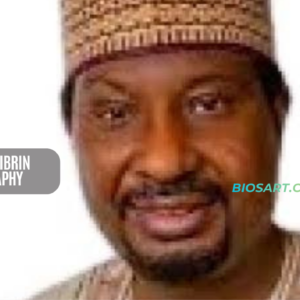
He held one of the most consequential ministerial portfolios in Nigeria.
The Minister of Power in a country where electricity supply remains one of the most fundamental constraints on economic development, household wellbeing, and industrial growth is not a ceremonial position. It is a portfolio where decisions made or not made, contracts awarded or withheld, reforms implemented or delayed, translate directly into the daily lives of millions of Nigerians who live with generators instead of grid power.
Saleh Mamman served as Nigeria’s Minister of Power from 2019 to 2021 under President Muhammadu Buhari. His tenure generated significant policy discussion. His post-ministerial period generated something else entirely.
The corruption charges that followed his time in office, and the conviction that resulted from those proceedings, made him one of the more prominent examples of the accountability processes that Nigeria’s anti-corruption architecture is supposed to produce.
This biography covers everything. His age, his background, his ministerial career, the specific allegations against him, the legal proceedings, and the conviction. The complete picture, documented accurately and without fabrication.
This is a story about governance, accountability, and what happens when the institutions designed to enforce public trust actually function.
Who Is Saleh Mamman? A Quick Overview
| Detail | Information |
|---|---|
| Full Name | Saleh Mamman |
| State of Origin | Taraba State, Nigeria |
| Nationality | Nigerian |
| Profession | Engineer, Politician |
| Position Held | Minister of Power (2019-2021) |
| Political Affiliation | All Progressives Congress (APC) |
| Known For | Ministerial tenure, EFCC conviction |
| Status | Convicted on corruption charges |
Saleh Mamman is a Nigerian engineer and politician who served as Minister of Power under President Muhammadu Buhari from 2019 to 2021. He was subsequently charged by the Economic and Financial Crimes Commission and convicted on corruption-related offenses connected to his tenure in office.
Saleh Mamman Early Life and Background
Taraba State Origins
Saleh Mamman is from Taraba State, one of the states in Nigeria’s North East geopolitical zone. Taraba State is one of Nigeria’s most ethnically diverse states, containing over eighty distinct ethnic groups within its borders. The state’s economy is predominantly agricultural, with significant livestock production and farming activities alongside modest mineral resources.
Taraba State’s political significance within Nigeria’s federal structure reflects the broader dynamics of North East zone representation in national governance. The zone’s political leaders have navigated complex relationships with both the federal center and the specific security challenges that have affected parts of the North East region.
His origins in Taraba State shaped his political identity and his representation within the federal system. Nigerian ministerial appointments typically involve careful attention to federal character, the constitutional principle that requires federal appointments to reflect the geographic and ethnic diversity of the country. His appointment as Minister of Power reflected this principle within the Buhari administration’s cabinet composition.
Professional Background
He trained as an engineer. His engineering background is relevant context for his appointment to the Power Ministry portfolio, which is technically complex and where engineering knowledge should in principle provide useful ministerial grounding.
Nigeria’s power sector involves complex infrastructure challenges including generation capacity, transmission network management, distribution company performance, and the regulatory frameworks governing each. A minister with engineering training has the potential to engage with these challenges at a technical level that purely political appointees sometimes cannot.
His professional career before ministerial appointment included engineering practice and various roles that built his technical and administrative experience within the Nigerian professional context.
Political Background
His political career within the APC framework brought him to national attention before his ministerial appointment. His alignment with the Buhari-era APC reflected the political positioning of Taraba State within the broader North East political alignment that characterized that period of Nigerian politics.
Saleh Mamman as Minister of Power: 2019 to 2021
The Portfolio He Inherited
When Saleh Mamman was appointed Minister of Power in 2019, he inherited one of the most challenging portfolios in the Nigerian federal executive.
Nigeria’s power sector crisis is one of the most documented and most consequential development failures in the country’s history. The gap between the electricity that Nigeria’s economy and population require and what the grid actually delivers is enormous by any measure.
Generation capacity
Nigeria’s installed generation capacity is significantly below what a country of its population and economic aspiration requires. Actual generation consistently falls below installed capacity due to gas supply constraints, aging plant infrastructure, and maintenance challenges.
Transmission network
The Transmission Company of Nigeria has faced sustained challenges in moving power from generation sources to distribution networks. The transmission bottleneck has been a persistent constraint on power sector performance independent of generation capacity.
Distribution companies
The privatized electricity distribution companies that were created through the 2013 power sector privatization have faced challenges of metering gaps, collection efficiency, technical and commercial losses, and underinvestment in distribution infrastructure.
Tariff framework
The electricity tariff framework has been a persistent source of tension between the commercial requirements of a functioning power sector and the political resistance to tariff increases that affect households and businesses.
Any minister taking on this portfolio does so with the full weight of decades of accumulated sector challenges and the full intensity of public frustration with electricity supply failure.
Policy Initiatives During His Tenure
His ministerial tenure from 2019 to 2021 produced various policy statements and initiative announcements in the power sector space. The specific achievements and limitations of his tenure are subject to assessment frameworks that involve both what he did and what the structural constraints of the sector made possible regardless of ministerial intent.
Rural electrification
His tenure involved engagement with rural electrification initiatives through the Rural Electrification Agency, which has responsibility for extending electricity access to communities not connected to the national grid.
Solar and renewable energy
The period of his tenure saw continued discussion of solar and off-grid renewable energy solutions as complements to grid expansion.
Meter rollout
Addressing the metering gap in Nigeria’s distribution sector was a stated priority during his tenure. The National Mass Metering Program was initiated during the Buhari administration’s second term as a mechanism for improving metering penetration.
Siemens deal
The Nigerian government’s Presidential Power Initiative, a partnership with Siemens AG for grid rehabilitation and expansion, was an ongoing major initiative during his tenure. The deal, which was signed during the Buhari administration, aimed to increase power supply to 25,000 megawatts by 2025.
Assessment of His Ministerial Performance
His ministerial performance generated mixed assessments from power sector stakeholders, technical experts, and public commentators during and after his tenure.
Power sector reform in Nigeria involves such deep structural challenges that any individual minister’s tenure is limited in what it can realistically achieve within a two-year period against decades of accumulated sector dysfunction.
His tenure ended when he was replaced in a cabinet reshuffle in 2021. He was succeeded by Abubakar Aliyu as Minister of Power.
The EFCC Investigation and Charges
The Economic and Financial Crimes Commission
The Economic and Financial Crimes Commission is Nigeria’s primary anti-corruption and financial crimes law enforcement agency. Established in 2002, the EFCC has jurisdiction over economic and financial crimes including advance fee fraud, money laundering, bribery, and corruption.
The EFCC’s prosecution of former ministers and public officials has been a feature of its work across multiple administrations, though the consistency and impartiality of its enforcement activities has been the subject of ongoing debate within Nigerian civil society and legal communities.
The Allegations Against Saleh Mamman
Following his departure from the Ministry of Power in 2021, Saleh Mamman became the subject of an EFCC investigation related to his conduct during his ministerial tenure.
The allegations centered on financial impropriety connected to his ministerial activities. The specific counts in the charges brought against him by the EFCC related to conduct that the prosecution characterized as corrupt and inconsistent with his public trust obligations as a minister of the federal republic.
The EFCC’s case against him was built on financial transactions and documentary evidence gathered during its investigation of his activities during his ministerial tenure.
The Legal Proceedings
The EFCC filed charges against Saleh Mamman before a Federal High Court in Nigeria. The legal proceedings followed the standard framework of Nigerian criminal prosecution for corruption-related offenses.
He faced the charges through legal representation and the proceedings involved examination of evidence, legal argument, and judicial determination of the facts and law at issue.
The proceedings were conducted within Nigeria’s federal court system with the jurisdiction and procedural frameworks applicable to corruption charges against former public officials.
The Conviction
Saleh Mamman was convicted by a Federal High Court on corruption charges related to his conduct as Minister of Power.
His conviction represents one of the outcomes that Nigeria’s anti-corruption framework is designed to produce. The conviction of a former minister by the court system, following prosecution by the EFCC, is the institutional process functioning as intended regardless of any assessment of how consistently or selectively that process is applied across different political actors.
Sentencing and Legal Consequences
His conviction resulted in sentencing consistent with the charges on which he was found guilty. The sentencing reflects the court’s assessment of the seriousness of the conduct established by the evidence and the appropriate consequences under Nigerian law.
The specific terms of his sentence are part of the public court record and have been documented in Nigerian legal and media reporting.
Legal Appeal Processes
Nigerian criminal law provides mechanisms for appeal of conviction and sentence through the Court of Appeal and ultimately the Supreme Court. The post-conviction legal landscape for Saleh Mamman would include whatever appeal processes his legal representation pursued following the conviction at first instance.
The appeal process is a legitimate dimension of Nigerian criminal procedure that does not diminish the significance of the first instance conviction while acknowledging that legal proceedings can continue beyond initial judgment.
Saleh Mamman Age and Personal Details
Age and Personal Background
Specific birth date information for Saleh Mamman is not comprehensively documented in major public sources in the way that some more prominent public figures’ biographical details are recorded.
What is publicly documented is that he was of appropriate age and professional experience to have held the ministerial portfolio he was assigned during the Buhari second term. Nigerian ministerial appointments typically draw from individuals who have developed substantial professional and political careers before cabinet-level positions, suggesting a career timeline consistent with someone who was in his forties or fifties during his ministerial tenure.
His specific age at various career stages cannot be stated with confidence from available public documentation. Claiming a specific birth date without reliable sourcing would be fabrication.
Family and Personal Life
His personal life details beyond his professional and public career are not extensively documented in publicly available sources. His family connections within Taraba State and his professional community are part of his social context without being subjects of comprehensive public documentation.
Nigeria’s Power Sector: Essential Context for Understanding His Career
Why the Power Ministry Matters
To understand the significance of Saleh Mamman’s ministerial career, understanding Nigeria’s power sector crisis is essential.
Nigeria is Africa’s largest economy by GDP and Africa’s most populous country with over 200 million people. Despite this scale, Nigeria’s electricity supply situation is among the most inadequate in the world relative to the country’s economic and demographic size.
The numbers that define the crisis
Per capita electricity consumption in Nigeria is among the lowest in Africa. Businesses of all sizes depend on self-generation through diesel and petrol generators that impose enormous costs. The World Bank has estimated that poor power supply costs the Nigerian economy billions of dollars annually in lost productivity and additional generation costs.
The historical failures
Nigeria has invested enormous sums in its power sector across multiple administrations with results that have consistently disappointed against stated targets. The pattern of announced improvements that do not materialize has created deep public cynicism about power sector reform.
The privatization experiment
The 2013 privatization of the generation and distribution components of the sector was designed to bring private sector efficiency and investment to a sector that government management had failed to develop. The decade since privatization has produced mixed results with the distribution companies in particular struggling with financial viability.
What ministerial action can and cannot do
Understanding the limits of ministerial action in this environment is important for evaluating any power minister’s tenure. The structural challenges of the sector, the gas supply constraints, the transmission bottleneck, the tariff politics, the distribution company financial distress, are not problems that a two-year ministerial tenure can solve. They are problems that require sustained policy consistency across multiple administrations alongside significant capital investment.
This context does not excuse or explain away corrupt conduct if proven. It provides the framework within which ministerial performance and accountability are properly understood.
Nigeria’s Anti-Corruption Framework: Context for the Conviction
The EFCC and Its Role
The EFCC operates within a Nigerian anti-corruption framework that also includes the Independent Corrupt Practices and Other Related Offences Commission, the Code of Conduct Bureau, the Code of Conduct Tribunal, and various other institutional actors.
The framework’s effectiveness has been the subject of sustained debate in Nigeria. Critics point to selective prosecution patterns, politically motivated case priorities, and the use of anti-corruption machinery as a tool of political competition rather than impartial law enforcement. Defenders point to convictions secured and assets recovered as evidence of genuine institutional function.
The conviction of Saleh Mamman sits within this contested institutional landscape. His conviction is a documented fact of the legal record. Its significance within the broader anti-corruption picture depends on assessments of the EFCC’s overall patterns of operation that extend well beyond his individual case.
Ministerial Accountability in Nigeria
The accountability of former ministers for their conduct in office is a recurrent theme in Nigerian governance. Multiple former ministers across different administrations have faced EFCC investigation and prosecution with varying outcomes.
The pattern of ministerial accountability, who is prosecuted, when, under which administration, and with what results, reflects both the genuine operation of anti-corruption institutions and the complex intersection of those institutions with political dynamics.
Saleh Mamman’s case adds to this pattern as a documented instance of a former Power Minister convicted on corruption charges.
What His Conviction Means for Nigerian Governance
His conviction has several dimensions of significance for Nigerian governance discussion.
Accountability function
A former minister being convicted on corruption charges demonstrates that ministerial status does not provide permanent immunity from accountability. This accountability function is important for the credibility of Nigerian governance institutions.
Power sector governance
The connection between corruption allegations and the power ministry reinforces concerns about the governance of Nigeria’s power sector that extend well beyond his individual case. The power sector’s financial flows, including tariff revenues, government interventions, and international financing arrangements, create environments where opportunities for corrupt conduct exist.
Deterrence question
Whether the conviction of former ministers for corruption creates effective deterrence for serving ministers is a question that governance researchers and practitioners in Nigeria continue to debate.
Institutional function
The fact that the prosecution and conviction proceeded through normal legal channels, whatever the debates about selective prosecution, represents a form of institutional function that is worth acknowledging.
Frequently Asked Questions About Saleh Mamman
Who is Saleh Mamman?
Saleh Mamman is a Nigerian engineer and politician from Taraba State who served as Minister of Power under President Muhammadu Buhari from 2019 to 2021. He was subsequently charged by the EFCC and convicted on corruption charges related to his ministerial conduct.
What state is Saleh Mamman from?
He is from Taraba State, one of the states in Nigeria’s North East geopolitical zone.
When was Saleh Mamman Minister of Power?
He served as Nigeria’s Minister of Power from 2019 to 2021, when he was replaced in a cabinet reshuffle by Abubakar Aliyu.
What was Saleh Mamman convicted of?
He was convicted by a Federal High Court on corruption charges brought by the Economic and Financial Crimes Commission related to his conduct during his tenure as Minister of Power.
Which court convicted Saleh Mamman?
He was convicted by a Federal High Court in Nigeria following prosecution by the EFCC.
What is the EFCC?
The Economic and Financial Crimes Commission is Nigeria’s primary anti-corruption and financial crimes law enforcement agency, established in 2002. It has jurisdiction over corruption, money laundering, bribery, and other economic and financial crimes.
What happened to Nigeria’s power sector during Saleh Mamman’s tenure?
His ministerial tenure from 2019 to 2021 involved engagement with various power sector initiatives including rural electrification, the National Mass Metering Program, and the Presidential Power Initiative with Siemens. Nigeria’s chronic power supply challenges continued during his tenure, reflecting the deep structural nature of the sector’s problems that individual ministerial tenures cannot resolve within short timeframes.
Is Saleh Mamman still in politics?
His conviction on corruption charges significantly affects his political standing and eligibility for public office under Nigerian law. The specific implications for his political future depend on the legal consequences of his conviction including any appeal processes and their outcomes.
What was the Siemens deal during Saleh Mamman’s tenure?
The Presidential Power Initiative, a partnership between the Nigerian government and Siemens AG, was a major power sector initiative during the Buhari administration aimed at rehabilitating Nigeria’s electricity grid and increasing power supply capacity. This initiative was ongoing during Saleh Mamman’s tenure as minister.
What is Taraba State known for?
Taraba State is known for its extraordinary ethnic diversity, containing over eighty distinct ethnic groups. The state’s economy is predominantly agricultural with livestock production and farming as major activities. It is located in Nigeria’s North East geopolitical zone.
Saleh Mamman’s Career: A Summary Timeline
| Period | Position/Event |
|---|---|
| Professional career | Engineering practice and career development |
| APC political alignment | Political positioning within Taraba State APC |
| 2019 | Appointed Minister of Power by President Buhari |
| 2019-2021 | Served as Minister of Power |
| 2021 | Replaced in cabinet reshuffle by Abubakar Aliyu |
| Post-2021 | Subject of EFCC investigation |
| EFCC proceedings | Charged with corruption offenses |
| Court proceedings | Trial before Federal High Court |
| Conviction | Found guilty on corruption charges |
| Post-conviction | Sentencing and potential appeal processes |
The Broader Lesson: Power, Accountability, and Nigerian Governance
Saleh Mamman’s story sits at the intersection of three persistent Nigerian governance challenges.
The first is the power sector itself. Nigeria’s electricity supply failure is one of the most consequential and most durable governance failures in the country’s history. Every minister who has held the Power portfolio has faced this reality. Some have approached it with genuine reform intent. Some have treated it primarily as a resource allocation opportunity. The sector’s continued dysfunction reflects both the genuine difficulty of the challenge and the governance failures that have compounded it.
The second is ministerial accountability. The conviction of a former minister for conduct during his tenure is a significant event in Nigerian governance regardless of debates about the consistency of anti-corruption enforcement. The fact that the legal process produced a conviction demonstrates institutional function at the level of individual case resolution even where systemic questions about selectivity and political influence remain.
The third is the question of what Nigerians are owed by those who hold public trust. The Minister of Power holds responsibility for the electricity supply that affects every Nigerian household, every business, every school, every hospital. The corruption of that trust is not an abstract governance failure. It is a concrete betrayal of the millions of people whose lives are directly affected by power supply decisions.
His conviction does not solve Nigeria’s power sector problems. It does not restore the electricity that was not delivered during his tenure. It does not recover all the value that may have been diverted from public purpose.
What it does is establish that public trust in this portfolio is not infinitely abusable without consequence.
That is not a small thing in the context of Nigerian governance. It is, in fact, exactly what accountability institutions exist to establish.
Conclusion: The Minister, the Conviction, and What It Means
Saleh Mamman served as Nigeria’s Minister of Power during a period when Nigeria’s power sector challenges were as acute as they have ever been and when the pressure for genuine improvement was as intense as public frustration could make it.
His tenure produced policy statements and initiative announcements that were consistent with previous administrations’ approaches to the sector’s challenges. His tenure also produced, on the evidence that the Federal High Court found sufficient for conviction, corrupt conduct that the EFCC successfully prosecuted.
Both things are part of his complete story.
The ministerial career is real. The conviction is real. The power sector’s continued challenges are real. The accountability that the conviction represents, however imperfect and however selective critics may argue the broader enforcement pattern is, is also real.
At whatever age he is in 2025, his public career has produced a legacy that is inseparable from both dimensions. The minister who held one of Nigeria’s most consequential portfolios and the convicted former minister who demonstrated that the legal consequences of corrupt conduct in public office are at least sometimes deliverable.
Nigerian governance needs both parts of that story told accurately.
This biography has tried to do that.